Blast From the Past

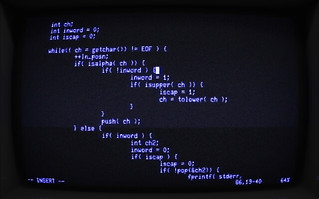
I found this program called Cathode that does an incredible job of recreating the experience of writing code on a CRT display, ca. 1980–83. Many was the hour I logged on the Lear-Sigler ADM-3A — in those days time was logged, so you could pay for it. That was incredibly unfair since the I/O (for l’users) was throttled down to 4800 baud.

CRT Recreation

Check it out. Then give it up, before the ergonomics make you blind.

As a sort of colophon, the code I’m editing here is genuine K&R C, from the Old Testament. There are two anachronisms:

  1. I’m using vi to edit it, but in the day I was busy getting all carpal with emacs. I had no choice here: there might be an Emacs on my system, but if there is, I can’t remember how to get out.
  2. I wrote this code in 1992, by which time we used terminal emulators like Kermit on PCs, instead of real terminals. However, it was a recreation of something I wrote in about 1983 to translate English into “Klingonese.” (Not the stuff used by Star Trek fans. That came later. I’m talking STA KANG, PUSHJ JRST.)

To be fair, I don’t think I ever wrote C on the ADM-3A, or even a VT-100. I don’t think the DECSystem-20 even had a C compiler. All my C was on the VAX, which had HP-2621A terminals.

Ruby 1.9 – Current Directory Not in RUBYLIB by default

For the most part, moving to Ruby 1.9 was pretty simple (apart from the FasterCSV issue). Today I stumbled on another problem, though: the current directory isn’t in your RUBYLIB path by default. Well.

Nice Piece on Using Vim

I ran across this nice reflection on the vim editor by someone who switched 18 months ago. In my own case, it was about 18 years. I’d been an emacs user forever, and it was just killing me (carpal tunnel, tennis elbow, and who-knows-what). So I made the switch to vi (and, soon enough, vim). It took awhile to get used to modes, but the alternative is playing Twister with my ring and pinky fingers.